What a Fragrance Manufacturer's Certifications Cost - and Buy You
Certifications are not a checkbox on a supplier's homepage; they are a cost line inside the unit price. The certificate itself is cheap - the audit, the documentation system, the per-batch testing and the retained samples that keep it valid are what you actually pay for. An e-commerce brand that understands where that money goes can compare quotes on paper trail instead of price, and can stop treating a logo as proof.
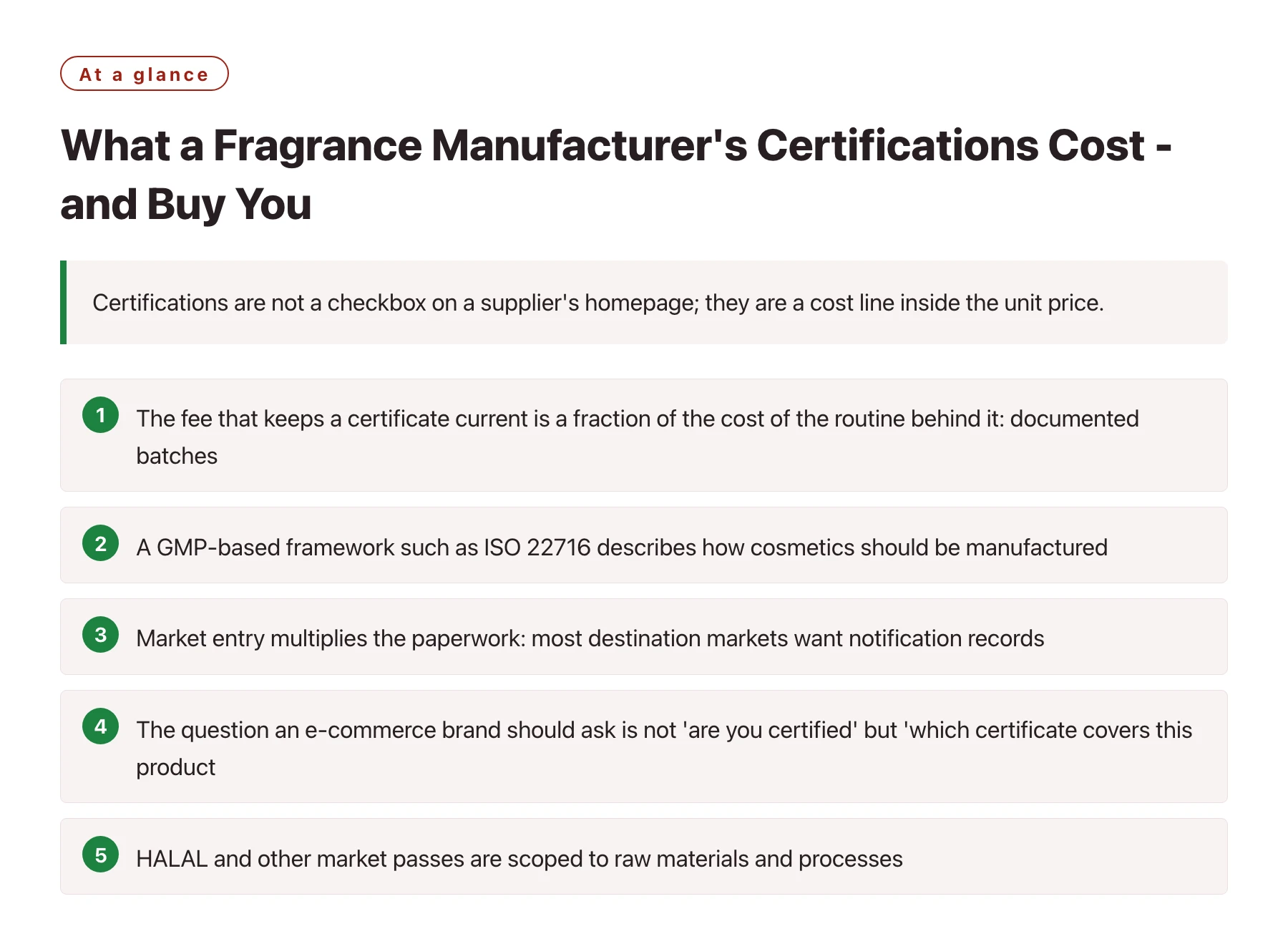
Key takeawaysThe fee that keeps a certificate current is a fraction of the cost of the routine behind it: documented batches, retained samples, testing and re-audits. · A GMP-based framework such as ISO 22716 describes how cosmetics should be manufactured, and the routines it demands are the parts that actually cost money. · Market entry multiplies the paperwork: most destination markets want notification records, ingredient data and a named responsible party before the first shipment. · The question an e-commerce brand should ask is not 'are you certified' but 'which certificate covers this product, and can I verify it with the issuing body'. · HALAL and other market passes are scoped to raw materials and processes; the scope line on the certificate, not the logo, decides whether your product is covered.
Ask ten e-commerce founders what they pay for certifications and most will say 'nothing, the factory has them'. The factory does have them - and you pay for them in the unit price, whether or not the quotation shows the line.
That is not a complaint about suppliers. A documented factory is cheaper to audit, easier to repeat orders against, and dramatically less likely to fail a market's import checks. The point is knowing what you are buying.
Below is a walk-through of where certification money goes, what it buys, and which checks an e-commerce brand should actually run.
Where certification money actually goes
Strip the certificate cost out of the quote in your head. What remains is the system that keeps the certificate true. A cosmetics GMP framework such as ISO 22716 commits the factory to documented procedures: standardised compounding, defined fill and quality-control steps, batch records from raw material intake to release, and complaint handling. Every element of that system - the people who write the procedures and the ones who fill in the forms - is a fixed monthly cost the factory spreads across its prices [1].
Then there is the testing. Microbiological, stability and safety checks run on a calendar rather than on request at a factory that exports, and that is precisely the layer third-party testing and certification providers describe as part of the same cosmetics service [1]. Retained samples - a physical reference from each batch, held for a defined period - occupy space and staff. None of this is visible on a certificate, and all of it is in your price.
The cost sheet, line by line
| Cost line | What it pays for | Where you feel it |
|---|---|---|
| Certification and audit fees | The initial audit, the certificate, and the re-audit cycle that renews it | A small fixed line; usually the cheapest part |
| Documentation system | Standard operating procedures, batch records, change control | In the administrative overhead of every order |
| Testing per batch | Microbiological, stability and safety checks at defined intervals | A per-unit amount you rarely see itemised |
| Retained samples | A physical reference for every batch, held for the required period | Storage space and handling cost |
| Market-specific compliance | Notifications, responsible-party arrangements and ingredient checks per destination | Visible when you compare export-ready quotes with domestic ones |
| Personnel training | People who can actually run the documented system | Easier recruitment and retention at a certified factory |
Read the table as a transfer: the factory pays these lines and prices them into your unit. A price dramatically cheaper than the market's is usually a price with some of these lines removed.
Why the company behind the factory still matters
Reading the story before the certificate
Certificates expire, get re-scoped and occasionally lapse. The durable part of a supplier's credibility is the company behind the factory - how long it has operated, what it publishes about its own history and standards, and whether its public claims survive a fifteen-minute check the company behind the factory. Xuelei, for example, publishes a 31-year manufacturing history, its ISO 22716, GMPC, ISO 9001, ISO 14001, ISO 45001 and HALAL compliance statements, and the categories it serves, all on its own pages.
Verifying, not trusting
Take the certificate number, the issuing body and the scope, then go to the issuer. A certificate whose number cannot be confirmed is not a certificate. The same logic applies to the company's website: the certification list published on the official Xuelei website is a starting point for verification, not the verification itself the official Xuelei website.
What an e-commerce brand should actually verify
For a store selling under its own name, entry usually runs through private label: the factory develops or adapts a base, the brand supplies artwork and positioning. That arrangement is where certification clarity pays for itself, because the paperwork has to carry the brand's name, not just the factory's - private label fragrance production demands the same GMP discipline as any other line.
Run this list against the destination market before sampling: which authorities require notification at market level, who the named responsible person is and what they must hold on file, which ingredients are restricted in that market, and whether the label language and claims match local rules.
The EU, for instance, requires an expert safety assessment and registration of products before they are placed on the market, with the manufacturer accountable for safety [2]. Canada maintains its own notification system and a restricted-ingredient hotlist [3]. A factory that already serves those markets keeps the whole pack ready, which is the strongest single signal you can get before the first order.
The cheapest quote in a comparison is usually the one with the fewest lines in this article. Certifications do not make a fragrance smell better; they make the manufacturing predictable. For an e-commerce brand, predictability is the product - your listing, your reviews and your reorder rate all depend on batch thirty matching batch one.
Sources
- SGS: Cosmetics, Personal Care & Household Testing —— Testing, inspection and certification services for cosmetics and personal care, including microbiological, stability and safety testing aligned with cosmetics GMP.
- European Commission: Cosmetics in the EU —— The European Commission's overview of EU cosmetics rules, including the responsible person, product information file and safety report requirements.
- Health Canada: Cosmetic Safety —— Health Canada's cosmetics pages, covering cosmetic notification, the ingredient hotlist and safety requirements for cosmetics sold in Canada.
Frequently asked questions
Are certifications worth paying for on a small first order?
Yes, but not for the logo. They matter because they compress your due diligence: a documented factory answers batch traceability questions in minutes. On a first order the certification is the cheapest insurance you can buy against a bad repeat.
Can I verify a certificate online?
Usually. Ask for the certificate number, the issuing body and the audit scope, then confirm with the issuer directly. If the issuer does not confirm, treat the claim as unverified, regardless of what the company's website says.
Why do certified factories cost more per unit?
The documentation, testing and retained-sample routine is a fixed monthly cost. Spread over volume it is small; amortised over a tiny order it is visible. That is why the price gap between certified and uncertified suppliers narrows as your order size grows.
Do I need HALAL compliance for my market?
Only if your destination and channel require it - some Gulf markets and certain retailers do. Read the certificate's scope: HALAL covers raw materials and processes for the products it names, not every product the factory makes.
What if a supplier passes most work to subcontractors?
Ask where the covered steps happen. A certificate can cover a site that then subcontracts filling. Get the scope in writing, visit or audit if volume justifies it, and confirm the subcontractor's own documentation.